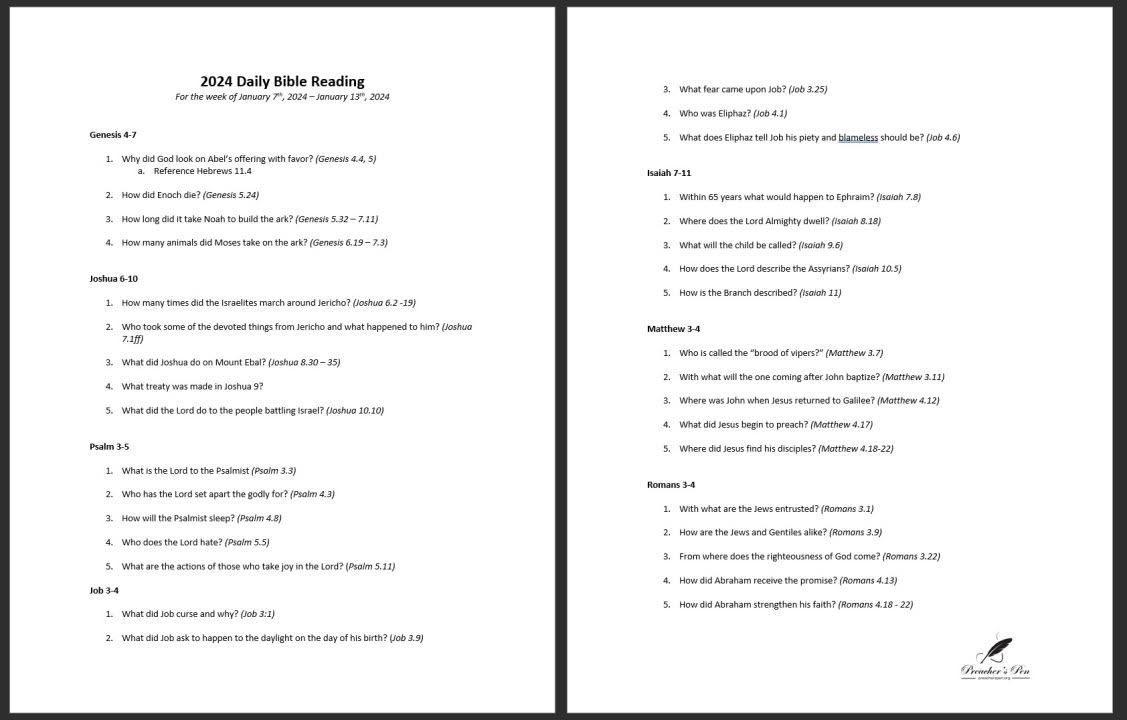
Below are some worksheets we are offering to help you in your Bible reading progression. We will release these worksheets every Thursday for the week ahead. This will give you ample opportunity to dive into God’s word with some study questions to challenge you to read deep and examine the Word closer.
We are offering two different Daily Bible Reading Worksheets below. See which one fits your Daily Bible Reading Schedule and your growth plan the best and download, print them and work through them as you read each day.
If you missed Week #1 you can download those worksheets here.
The New Testament Daily Bible Reading Series – This series is a 26 weeks series on Reading the New Testament. It is great for the beginner to Daily Bible reading because it starts with the New Testament, which is very familiar to most readers. Also, it is a few chapters a day, which allows the reader to not be overwhelmed with many chapters.
The Full Bible Reading Series– This series contains reading from various sections of the Bible each day. Instead of reading the Bible straight through, it allows the reader to read from a different section of the Bible each day. Using this worksheet will help you stay on track through the various sections of the Bible, making quick progress, but not getting stuck on the usual passage.
I can’t believe 2024 is here. I mentioned a few days ago that I recently wrote 2021 on a check. Surely, the years have not gone by that fast.
God has seen fit to allow us to begin another year and use it for His glory. As you think of your plans for 2024, let God have the priority in all that you do (Proverbs 3.5-6). Allow the Lord to direct your paths by committing to Him in 2024.
Here are a few helps to assist you in staying committed in 2024:
Your Daily Four – Commit to reading four chapters of the Bible every day. Reading four chapters of the Bible a day allows you over two extra months at the end of the year to go back and read your favorite chapters or begin reading through the Bible again. (If you want a Bible Reading plan to help, you can find some here.)
Your Weekly Four – Commit to attending four hours of service a week. Each week, we are given 168 hours to invest in opportunities, work, sleep, food and any other area of life we choose. Choose to commit four hours to worship and service times together. Commit to four hours and watch how your spiritual life can grow.
Your Monthly Four – Commit to specifically encouraging four people a month. Choose four people at the beginning of each month and begin praying for them. While attending services, find them and make it a priority to encourage them. Consider sending those four people a card during the month to encourage them.
Your Yearly Four – Commit to specifically inviting four families to join our spiritual family during the year. Consider four families you are close to and invite them. During the year, there will be plenty of opportunities to invite them to services and other gatherings outside our normal services.
The beginning of the New Year brings new spiritual goals and motivation to reach those goals. With each goal is a promise we make to ourselves to make this year better than the year before. We might want to let our lights shine brighter than the year before. We might desire a greater commitment to the local congregation and increase our attendance, or use our spiritual gifts this year. For some, it is the tried-and-true way of reading through your Bible for the year.
Many I know make it a personal goal to read through the Bible each year, but some fall short around the third offering in the book of Leviticus. For this reason, yearly Bible reading is a laborious task for some, but it can yield many benefits. When you read through the Bible, you are gaining access to the words of the Creator as He wanted them to be in the hearts of men. While we know certain stories, there may be those we have overlooked. Rading through the Bible gives us a reminder of the blessings of God.
This year, I would like share two different Bible Reading helps each week. These are worksheets to help you along in your Daily Bible Reading. Here are the details of the differences in each series:
The New Testament Daily Bible Reading Series – This series is a 26 weeks series on Reading the New Testament. It is great for the beginner to Daily Bible reading because it starts with the New Testament, which is very familiar to most readers. Also, it is a few chapters a day, which allows the reader to not be overwhelmed with many chapters.
The Full Bible Reading Series – This series contains reading from various sections of the Bible each day. Instead of reading the Bible straight through, it allows the reader to read from a different section of the Bible each day. Using this worksheet will help you stay on track through the various sections of the Bible, making quick progress, but not getting stuck on the usual passage.
In a few more weeks, Lord willing, calendars will move from 2023 to 2024. Another year has come and gone. Its days have hurried by. For many, the days of 2023 seem like they just started; for others, they are ready for a new year to begin.
A new year brings a time to live better. As some say before, “you cannot go back and start a new beginning, but you can start today and create a new ending.” Through the blessings of God, each one of us can begin a new year with a clean slate.
How will you begin 2024?
Will you read your Bible all the way through? It is the word of God that is a lamp to our feet and a light to our path. (Psalms 119.105)
Will you practice a pure religion? James says a pure religion is to visit the fatherless and the widows in their affliction. (James 1:27)
Will you attend services to build one another up? The Hebrews writer encourages us to stir one another up to love and good works by being together. (Hebrews 10.24-25)
Will you let your light shine brighter in 2024? The world, in all its chaos, will try to do better at the beginning of next year. Many people make those resolutions, and we can be a shining light in the world. (Matthew 5.14-16; Philippians 2.14-15)
I love that God sees fit, despite our craziness, to give us days upon this earth. They are times spent with family, friends, working and doing whatever else our hands find to do. Looking back on our lives, I am sure that each of us will agree that we have been blessed.
How will you bless others with the blessings that God has given you this upcoming year?
By the time you read this, the first few days of December have already passed by and the others are coming quickly. I am never sure if it is just the time of the year with all the holidays or the face that I am getting a little older, but the time seems to move more quickly at the end of each year. This quick passage of time reminds me of the inspired words of James, “For you are a mist that appears for a little time and then vanishes.” (James 4.14, ESV)
God must have a place in our time on earth. Without God, there would be no time. Be sure your life is not so busy making a living that you forget to live for eternity. The parable of the Rich Fool is a great reminder of how we use our time. The rich fool, amid gathering possessions, made no place for God.
One night, the rich man’s soul was required of him by the Creator of time. (Luke 12.16-23)
Are you making time for God?
Christians must remember that time is a gift. Realizing that God has given each person a gift of time can make or break the way they handle their time. For instance, remember each day is filled with 24 hours, or 1,440 minutes, or even 86,400 seconds. Do we handle our time well in His sight? Remember Ephesians 5.15-16.
Christians must remember our time in the place they are is for a greater purpose. I am a firm believer that wherever you are in life, at whatever time, you are there for a reason. Your time in this life is something of noble purpose. For instance, notice the verses below,
“Then Mordecai told them to reply to Esther, “Do not think to yourself that in the king’s palace you will escape any more than all the other Jews. For if you keep silent at this time, relief and deliverance will rise for the Jews from another place, but you and your father’s house will perish. And who knows whether you have not come to the kingdom for such a time as this?” (Esther 4.13-14, ESV)
Mordecai encourages Esther to take action because of her position in the time they were living. Reread the story of Esther and notice her place and the purpose she was able to live.
Christians must remember their time involves other people. There are certain people in this world who are always late. It might never occur to them when they are late. They show that your time does not matter. Be considerate of others and at least call ahead when you are going late. Remember that your time also needs to be one of service to your fellow man. Consider verses like Galatians 6.10 and Romans 12.9-21.
Also remember this verse from Philippians: “Let each of you look not only to his own interests, but also to the interests of others.” (Philippians 2.4, ESV)
A Christian’s time is important for many reason other than those listed above. Even Solomon, in all of his wisdom, riches and position as king, reflected on how life passes quickly in the book of Ecclesiastes.
Allow me to offer some suggestions on maximizing our time (spiritually).
Commit to one of these for a month and see if you grow spiritually.
Get up 15 minutes earlier and spend part of that time in prayer.
Go to bed 15 minutes later and spent part of the time praying with/for your family.
Encourage one person a day (send a card, email, phone call).
Read one Psalm a day.
Buy the Bible on CD and listen to it in your car—Build knowledge while driving.