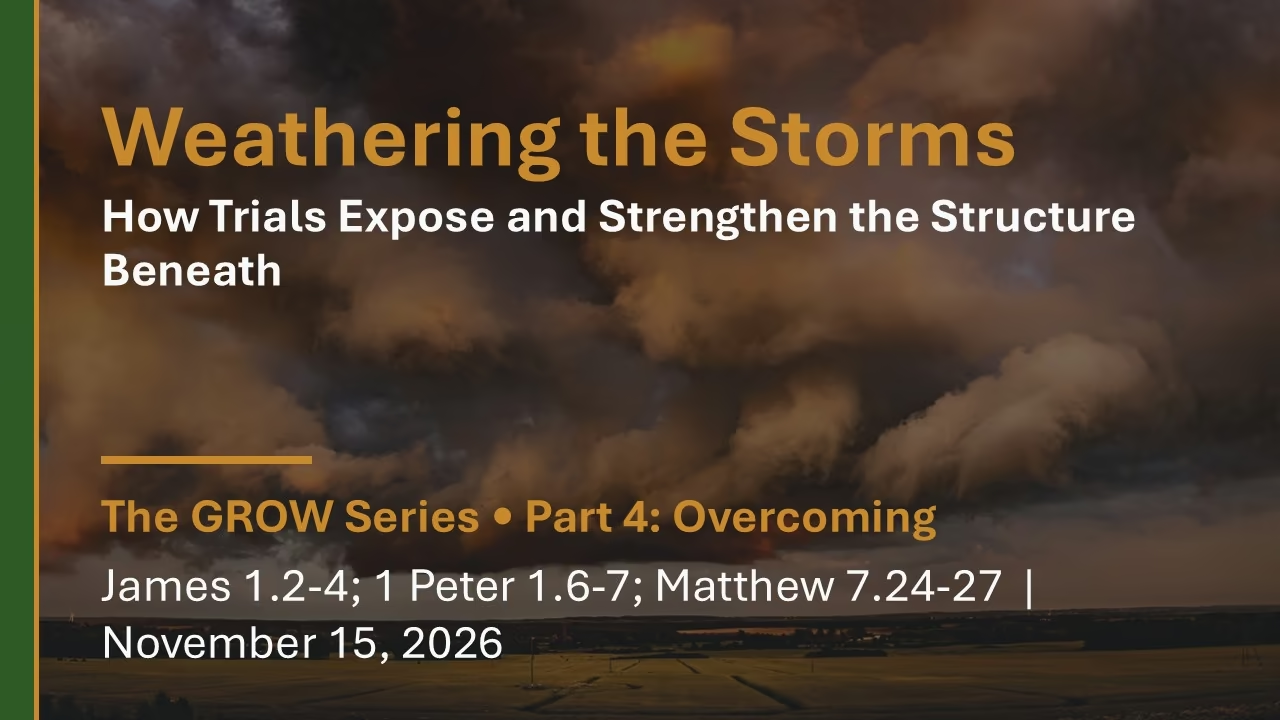
If you have lived in the South for more than one spring, you already know that southern weather does not ask permission. Tornado watches, flash floods, and a March wind that lays a pine across a power line are part of the local dialect.
Life keeps its own forecast too: a diagnosis, a pink slip, a midnight phone call, a marriage under pressure, or a faith that suddenly feels thin. The question was never whether the wind would come. James settled that when he wrote "when you meet trials," not "if" (James 1.2).
Most of us spend our prayers asking God to stop the wind. Scripture keeps asking a harder question: what is the wind doing to you?
Count It Like a Bookkeeper
"Count it all joy, my brothers, when you meet trials of various kinds, for you know that the testing of your faith produces steadfastness" (James 1.2-3). Notice that James did not tell you to feel happy about the pain. "Count" is a ledger word, so you are deciding how to enter the trial in the books of your faith, not pretending it feels good when it plainly does not.
Joy in James is not a grin glued over grief. It is the settled confidence that God can build something in the storm that calm weather never would.
James says to "let steadfastness have its full effect, that you may be perfect and complete, lacking in nothing" (James 1.4). The danger is not only the trial. The danger is bailing out of the trial early through bitterness, escape, or a faith that smiles on Sunday and quits on Tuesday. If you cut the work short, you may lose the very strength God was building.
Trees That Never Felt the Wind
Outside Tucson, Arizona, sits Biosphere 2, a sealed glass and steel habitat built in the early 1990s as a closed ecological experiment. Writers and visitors have reported for years that trees inside the enclosure grew quickly and then grew weak, with some breaking or falling under their own weight in a world without normal outdoor wind.
Plant scientists have studied this for decades, and Frank Telewski of Michigan State summarizes the research plainly: trees that are flexed by wind grow less tall, but they develop thicker stems, stronger roots, and better wind resistance than trees that are never flexed.
A tree can look impressive and still be weak if nothing has ever pushed on it, and the same is true of a Christian. A faith that never leans into the wind may look fine in calm weather and snap in the first real storm. That does not mean God handpicked every hard thing in your life, but it does mean the wind you are leaning into right now may be the very thing that keeps you standing later.
Same Storm, Different Foundation
Jesus ended the Sermon on the Mount with a weather report. "Everyone then who hears these words of mine and does them will be like a wise man who built his house on the rock" (Matthew 7.24). Both builders got the same rain, the same floods, and the same wind. One house "did not fall, because it had been founded on the rock" (Matthew 7.25). The other "fell, and great was the fall of it" (Matthew 7.27).
The difference was never the forecast. The difference was what each man did with what he heard. James puts it bluntly: "be doers of the word, and not hearers only, deceiving yourselves" (James 1.22). Luke adds that the wise builder "dug deep and laid the foundation on the rock" (Luke 6.48).
You can fill a notebook with sermon notes and still be building on sand if the words never make it into your Monday. A storm will show you whether your habits were decoration or load-bearing walls.
What the Fire Proves
Peter writes to Christians who were hurting, and he does not pretend otherwise. "In this you rejoice, though now for a little while, if necessary, you have been grieved by various trials" (1 Peter 1.6). Grieved is an honest word, because biblical faith never asks you to fake a smile while your heart is in pieces.
Peter then explains the purpose: the tested genuineness of your faith is "more precious than gold that perishes though it is tested by fire" (1 Peter 1.7). He is borrowing from the assay office, where metal is tested to find out what it really is. "The crucible is for silver, and the furnace is for gold, and the Lord tests hearts" (Proverbs 17.3).
Be careful what you pin on God. Some pain comes from sin, some from a broken world, and some from the devil himself. What the fire can do, in the hands of the Lord, is show what is genuine in you and burn off what is not.
Where Are You Standing?
If you have been hearing Jesus without obeying Him, you are building on sand, and the forecast is not in your favor. Come to the rock the way the Bible describes it. Hear the word, because "faith comes from hearing, and hearing through the word of Christ" (Romans 10.17). Believe, repent, confess Jesus as Lord, and be baptized "for the forgiveness of your sins" (Acts 2.38). Then remain faithful through every season that follows.
If you are already a Christian and the wind is howling right now, do not waste the storm. Peter promised that "after you have suffered a little while, the God of all grace, who has called you to his eternal glory in Christ, will himself restore, confirm, strengthen, and establish you" (1 Peter 5.10).
The slides from Sunday's lesson are free to download below.
Here is your next step: read James 1.2-12 every morning this week. Pick one trial you are facing and write a single sentence about what steadfastness could look like if you stay with God in it. Then do one thing you have only been hearing about, and dig one shovel deeper into the rock before the next storm rolls in.
Just some thoughts.