Are you looking to deepen your Bible reading experience and enhance your spiritual journey?
Look no further!
In this guide, we will explore 10 steps to transform your Bible reading experience and help you connect more deeply with the teachings of God. Whether you are a new believer or have been following Christ for a long time, these practical strategies will help you approach the Bible with intentionality and gain greater understanding.
We will cover a range of topics, including the importance of setting a routine, the significance of choosing the right translation, and the practical application of the teachings in your daily life. Get ready to embark on a transformative journey as we delve into the world of effective Bible reading.
Let’s dive in!
A Transformative Approach
My Personal Journey to Effective Bible Reading
My journey to effective Bible reading was not without its challenges. Even though I “grew up in the church,” it took me a while to find the best way to me to read the Bible in a way that stuck with me. Over time, I learned that understanding the Bible was not about racing through chapters, but about delving deep into the Word of God. It was easy for me to race through the books just to see how fast I could get them done, but doing so overlooked many passages I needed to know. Sometimes, I began with sporadic reading, often just picking up the Bible when I felt the need. This approach, however, did not offer consistency or depth of understanding.
I soon realized the need for a more structured approach. I made Bible reading a part of my daily routine. This was a game-changer. Not only did consistent reading deepen my understanding, but it also built a connection that went beyond mere words. A simple, consistent way is to read a chapter of Proverbs a day doe each day of the month. For example, on the first day of the month, you read chapter 1. One day 2, you read chapter 2. I think you get the point.
Choosing the right translation was another critical step. Initially, I found myself lost in language that I may not fully understand, which distanced me from the teachings. There is nothing wrong with using an older translation, but finding one that keeps accuracy in the text while using more modern-day language was a benefit. Once I found a translation that fit the requirements of accuracy and meaning, the scriptures started resonating more meaningfully.
Today, I approach Bible reading with an open heart and mind, bringing its teachings to life in my daily actions. This journey has been transformative, and I hope to impart the lessons learned to you through this guide.
Step 1: Establishing a Reading Routine
Practical Tips for Consistent Bible Study
These steps made am immediate difference in my personal Bible Study.
Creating a consistent Bible study routine is an important first step to enhance your Bible reading experience. Here are some practical tips that can help you in this endeavor:
Set Aside Dedicated Time: Choose a specific time each day for Bible reading. It could be early in the morning, during your lunch break, or before bedtime. Consistency is key, and having a designated time helps build a habit.
Start Small: You don’t have to read large chunks of the Bible in one sitting. Start with a few verses or a chapter a day and escalate your reading as you become more comfortable.
Use A Reading Plan: Bible reading plans can provide a structured approach to navigate the scriptures. They give you a roadmap of what to read each day, helping you cover the entire Bible over a set period.
Reflect and Journal: After each reading session, spend some time reflecting on what you’ve read and jot down your thoughts. This practice aids in better understanding and keeping the teachings.
Remember, the goal is not to rush through, but to understand and absorb God’s teachings. So, take your time, be patient with yourself, and enjoy the journey.
Step 2: Selecting the Right Bible Translation
Choosing a Translation that Hold Accuracy and the Meaning
Selecting the right Bible translation is a deep choice and can significantly influence your understanding and connection with the scriptures. Here are some factors to consider when choosing a translation:
Comprehension: The Bible should be something you can understand easily. If a translation uses language that feels too archaic or complex, it might create barriers to understanding. Look for a translation that uses simple, contemporary language that you are comfortable with but holds the accuracy and the meanings of the original text.
Accuracy: While readability is important, you also want to ensure the translation is accurate and faithful to the original texts. Some translations aim for a word-for-word representation, while others focus on conveying the overall meaning.
Personal Connection: Lastly, choose a translation that resonates with you on a personal level. Reading the Bible is a spiritual journey, and the translation you choose should speak to your heart.
Try out different translations and don’t rush this process. Remember, the goal is to find a translation that helps you better understand God’s Word and apply it to your daily life.
Steps 3: Applying Biblical Teachings to Daily Life
Exploring Strategies for Active Faith Integration
Applying biblical teachings to your daily life is the goal of Bible reading. Here are some strategies for active faith integration:
Reflect on the Teachings: After each reading session, reflect on the teachings, and think about how you can apply them in your life.
Pray for Guidance: Prayer is a powerful tool for spiritual growth. Ask God to guide you in understanding His Word and applying it to your life.
Share with Others: Share what you have learned with others. This not only helps you reinforce your understanding but also encourages others in their spiritual journey.
A Bónus: Live the Teachings: Strive to live the teachings of the Bible in your daily actions. Whether it’s showing love and kindness, being honest, or helping others, let the teachings guide you in your daily life.
Incorporating these strategies can help you live out your faith more actively. Remember, the journey of faith is a marathon, not a sprint. Be patient with yourself, rejoice in small victories, and continue to seek God’s guidance in your life.
Are you looking to deepen your Bible reading experience and enhance your spiritual journey?
The apostle Peter is usually known for two things:
(1) putting his foot in his mouth quite often and
(2) delivering the sermon on the day of Pentecost in Acts 2.
Those two events in Peter’s life are his most well-known, but also a testimony to his personal growth.
Peter followed Christ after his brother Andrew brought him to see Jesus (John 1.41-42). Who knew that fisherman from a small town in Galilee would follow the Messiah for three years, open his mouth too soon, yet stand before other followers of Jesus and deliver a message which would, through the power of God, convert over 3,000 people from the beginning. (Acts 2.41)
Who knew?
I believe God knew. God knew that one person had the power to share a message and convert others. Jesus knew. From their first meeting, Jesus called Peter “Cephas” which means rock. Whether it is a look into Peter’s character or his firmness in his beliefs, we know that the word “rock” would mean greater things as the years went on. (Note Matthew 16.16-18)
What caused such growth in Peter? What caused Peter to go from being a fisherman to a gospel preacher? What allowed Peter to go from an open mouth to preaching from an open heart?
Peter was not a PH.D. candidate, nor was he a theological scholar, yet the Jewish leaders noticed something about his life. They noticed that this “uneducated, common” man had been with Jesus. (Acts 4.13)
Because Peter spent time with Jesus, people saw his boldness and his life. Spending time with Jesus not only changed Peter’s life, but it will change your life.
How can you spend time with Jesus? Open his words and spend time with His followers being encouraged together.
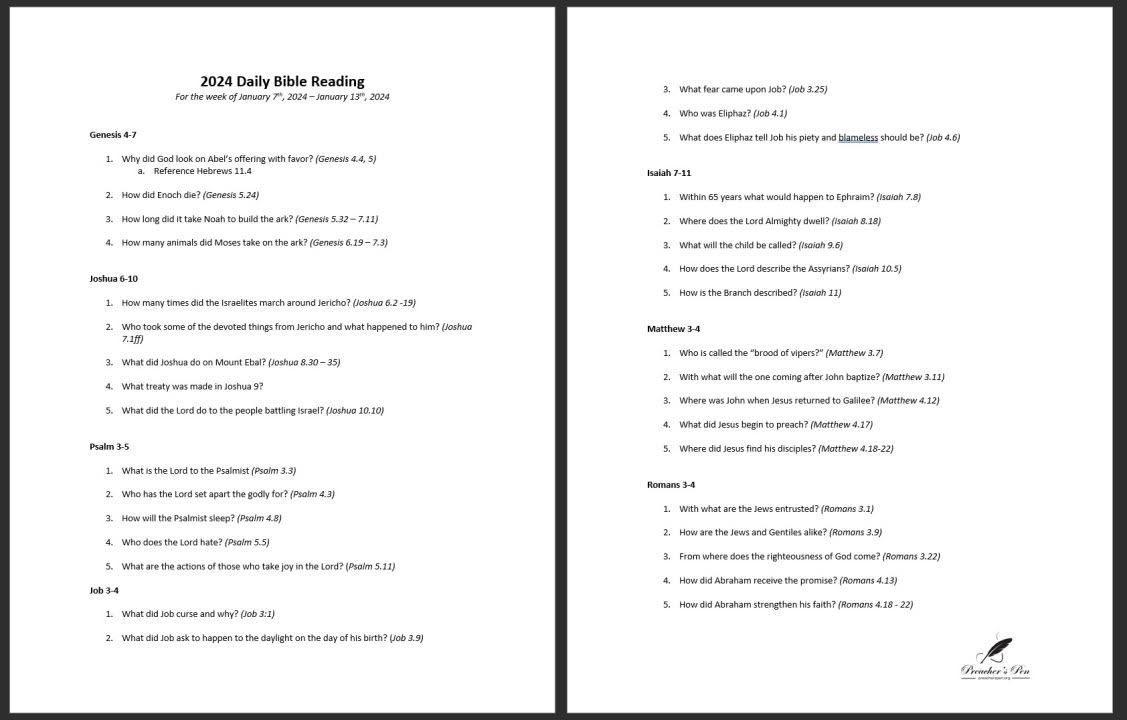
Below are some worksheets we are offering to help you in your Bible reading progression. We will release these worksheets every Thursday for the week ahead. This will give you ample opportunity to dive into God’s word with some study questions to challenge you to read deep and examine the Word closer.
We are offering two different Daily Bible Reading Worksheets below. See which one fits your Daily Bible Reading Schedule and your growth plan the best and download, print them and work through them as you read each day.
If you missed Week #1 you can download those worksheets here.
The New Testament Daily Bible Reading Series – This series is a 26 weeks series on Reading the New Testament. It is great for the beginner to Daily Bible reading because it starts with the New Testament, which is very familiar to most readers. Also, it is a few chapters a day, which allows the reader to not be overwhelmed with many chapters.
The Full Bible Reading Series– This series contains reading from various sections of the Bible each day. Instead of reading the Bible straight through, it allows the reader to read from a different section of the Bible each day. Using this worksheet will help you stay on track through the various sections of the Bible, making quick progress, but not getting stuck on the usual passage.
I can’t believe 2024 is here. I mentioned a few days ago that I recently wrote 2021 on a check. Surely, the years have not gone by that fast.
God has seen fit to allow us to begin another year and use it for His glory. As you think of your plans for 2024, let God have the priority in all that you do (Proverbs 3.5-6). Allow the Lord to direct your paths by committing to Him in 2024.
Here are a few helps to assist you in staying committed in 2024:
Your Daily Four – Commit to reading four chapters of the Bible every day. Reading four chapters of the Bible a day allows you over two extra months at the end of the year to go back and read your favorite chapters or begin reading through the Bible again. (If you want a Bible Reading plan to help, you can find some here.)
Your Weekly Four – Commit to attending four hours of service a week. Each week, we are given 168 hours to invest in opportunities, work, sleep, food and any other area of life we choose. Choose to commit four hours to worship and service times together. Commit to four hours and watch how your spiritual life can grow.
Your Monthly Four – Commit to specifically encouraging four people a month. Choose four people at the beginning of each month and begin praying for them. While attending services, find them and make it a priority to encourage them. Consider sending those four people a card during the month to encourage them.
Your Yearly Four – Commit to specifically inviting four families to join our spiritual family during the year. Consider four families you are close to and invite them. During the year, there will be plenty of opportunities to invite them to services and other gatherings outside our normal services.