Proverbs for Graduates

Proverbs for Graduates

There are many thoughts which can be shared, but the book of Proverbs shares many timeless wisdoms, which finds the application beyond a graduation.

Solomon speaks from his experiences regarding life, decisions, marriage, knowledge, riches, poverty, and humbleness.

Consider Solomon’s inspired words in Proverbs 4.23-27 and how they will be a guiding light to the feet of those willing to investigate the sacred text. Each verse is a treasure of knowledge to guide your steps.

I would encourage you to take these verses to heart and use them each day as you walk in your new season of life.

  1. “Keep your heart with all vigilance, for from it flow the springs of life.” (Proverbs 4:23)
  2. “Put away from you crooked speech, and put devious talk far from you.” (Proverbs 4:24)
  3. “Let your eyes look directly forward, and your gaze be straight before you.” (Proverbs 4:25)
  4. “Ponder the path of your feet; then all your ways will be sure.” (Proverbs 4:26)
  5. “Do not swerve to the right or to the left; turn your foot away from evil.” (Proverbs 4:27)

I would encourage each graduate, and each Christian, to take these verses to heart and use them each day as you walk in your new season of life.

Allow your life to flow from the lessons you have and will learn in the Scriptures. Let them be a light to your path and a lamp to your feet.

Just some thoughts,

Signature File

What Would Yours Say?

What Would Yours Say?

On November 16, 2020, Radio France International made a blunder that made people laugh, yet they questioned why such a mistake would occur. The mistake also got people thinking, “I wonder what mine would say?”

Someone made a mistake and posted close to 100 obituaries on the Radio France International website. It does not sound like a mistake until you know those people were not dead.  The obituaries included people such as Clint Eastwood, soccer legend Pele, and even Queen Elizabeth.

Within a few hours, readers let the website know of the error and the pre-written obituaries were taken down.  Later, an apology note was posted to help clear up the error.

To think that someone is writing obituaries before a person passes away might sound odd, or even morbid, but it happens each day. Each of us are writing our own obituary as we live each day. Our lives are in constant motion and people will remember our lives, no matter what the written words say.

This mistake on the Radio France International website should serve as a remind that we are writing our obituaries as we live, but also, our death in this life is certain. So, here are a few questions to think about…

  • What would your obituary say?
  • How do you want to be remembered by your family?
  • How do you want to be remembered by your friends?
  • How do you want to be remembered by those who read your obituary?

But most important, no matter who remembers you, will they remember you as a shining light for Christ? Will they remember you as a Christian?

Just some thoughts,

Signature File

When the Air is Out of the Ball

When the Air is Out of the Ball

On August 30, 2020, A legendary figure in college basketball passed away. Whether you liked him or not, you respected the drive and the coaching style of John Thompson.

John Thompson coached the Georgetown Hoyas for 27 seasons (1972-1999) and led them to 20 tournaments appearances, 3 Final Four appearances and one NCAA championship.  After his retirement in 1999, he was inducted to the Basketball Hall of Fame.

However, what you may not know is, during his coaching years, 97% of the student-athletes under Coach Thompson finished with a degree.  This effort was by design because coach Thompson knew they needed to achieve academically.

Coach Thompson kept a deflated basketball in his office as an illustration to players. He did this to show them there is a life after sports. This simple visual aid reminded players that after basketball is over, there is still a life to be lived. Simply put, one day the air will be out of the ball, and what will you do next?

As an example to everyone’s life, like a deflated basketball, there will be a day when the air within us will be gone, and we must answer the question, “Are we prepared for what comes next?”

“The end of the matter; all has been heard. Fear God and keep his commandments, for this is the whole duty of man. For God will bring every deed into judgment, with every secret thing, whether good or evil.” (Ecclesiastes 12:13-14)

When the air has gone out, are you prepared for what comes next?

Just a thought,

Signature File

Why Do You “Go the Church?”

Why Do You “Go the Church?”

I know many people would prefer to say, “We are the church and we go to the building”, but the term, “go to church” can mean when one attends or goes to the assembly.

The question this week is, “Why do you go to church?”

In a recent article found in the Spring 2020 issue of Preaching magazine, J. D. Greear cites some research from Great Britain regarding religious practices. The research referenced that “70% of British people never anticipate going into a church in their lifetime.” These results shown the British may be more secularized than anyone may think.

Dr. Greear also stated that these results did not indicate they were mad at the church or trying to avoid it. The research shows those surveyed could not see a reason to go to church.

Can you imagine 70% of a nation (if the survey is consistent) would see no reason to attend services of the church? What if those results were the same in our country? What about in our state? What about in the Gadsden area?

Acts, the book of history in the New Testament, reveals that the early church met together every day and found encouragement. Not only did they continue to teach one another (Acts 5.42) but they also shared what they had with each other (Acts 2.44).

Not only did the early church meet to worship (Acts 2.42) but they continued to meet because of their relationship. It was necessary for them to meet to “stir up one another.” (Hebrews 10.24)

So, back to the question, “Why do you go to church?”

Just a thought,

Signature File

How Much Does a Marriage Cost?

How Much Does a Marriage Cost?

Several years ago, an article crossed my desk titled, “Most Costly Celebrity Divorces.” Normally, I would ignore an article like that, but curiosity got the best of me. The article was nothing more than an article about the divorce settlement in terms of money. The article never discussed the “cost of divorce” without terms of money. Divorce costs lives, relationships and more.

Marriage is more costly than money. A great marriage is an investment, not only in your future, but for future generations. A bad marriage is a costly expense, not only in your life, but in the lives of future generations.

Your marriage not only affects you, but it influences your children on the type of marriage they will have. As the Bible says, our lights will shine for others to see.  (Matthew 5.14-16) We provide an example to others regarding marriage. If we speak harsh about marriage, others will see it as harsh. If we speak well of marriage, others will see it differently than before.

How to Improve the Value of Marriage:

  • Value Marriage – To improve the value of marriage, you must value marriage. The Bible places a high value on marriage as it uses it as an illustration of Christ and the church. (See Ephesians 5.22-33)
  • Work on Your Marriage – Marriage takes work. Some people believe that once the wedding is over it is all happily ever after. Instead, marriage takes work. Submission takes work. Responsibility takes work. (See Ephesians 5.22-33)
  • Believe the 100/100 truth – The typical saying is that marriage is 50/50, but the truth is that marriage is 100/100. When two people enter a relationship and only give 50%, there will be problems. When two people enter marriage giving 100%, they will become one flesh and grow their marriage.

Just a thought,

Signature File

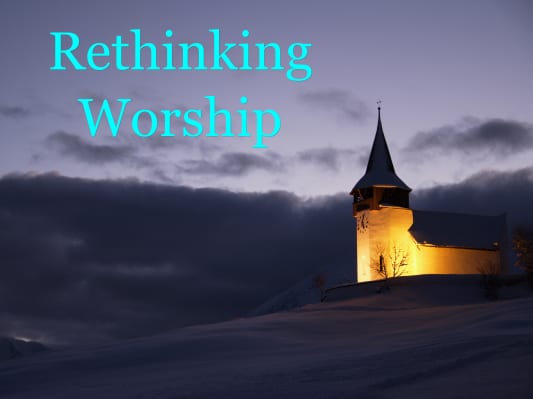
ReThinking Worship

ReThinking Worship

From coffee cups, water bottles, and even snack containers; these are the items that litter many church auditoriums following brief periods of worship. Stuffed in the pockets of the seats are handwritten notes regarding the afternoon activities and future events of the day. In fact, the newest church seats resemble theatre seats equipped with cup holders more than the pews of piety from years past. The flashes of light against a screen, called PowerPoint, are the highlight of the service instead of humbly bowing before the Almighty.

Each Sunday for one hour members fill an auditorium for “worship.” For many, this may be the only time each week they worship God. For others, this will begin their week of worship. While each person may be drastically different, we all understand that worship is a part of our lives. The question may be, “How well do we respect our worship?”

My friends, I submit to you today, that we clearly see our respect for God in our worship of Him.

Let me pose a few questions for you to consider:

  • If our minds are not focused on the Father during the week, how can one hour on Sunday morning suffice?
  • If our worship is filled with what we want, when do we live in what God wants?
  • Do our children see us worshipping God, or respecting the world?

Hard questions deserve hard answers!

Take a moment and consider the words of A. W. Tozer this day:

“Christian churches have come to the dangerous time predicted long ago. It is a time when we can pat one another on the back, congratulate ourselves and join in the glad refrain, ‘We are rich, and increased in goods, and have need of nothing!’

“It certainly is true that hardly anything is missing from our churches these days—except the most important thing. We are missing the genuine and sacred offering of ourselves and our worship to the God and Father of our Lord Jesus Christ.…

“My own loyalties and responsibilities are and always will be with the strongly evangelical, Bible-believing, Christ-honoring churches. We have been surging forward. We are building great churches and large congregations. We are boasting about high standards and we are talking a lot about revival.

“But I have a question and it is not just rhetoric: What has happened to our worship?”


A. W. Tozer, Whatever Happened to Worship (Camp Hill, PA: Christian Publications, 1985), 9–10. 

Morgan, R. J. (2000). Nelson’s complete book of stories, illustrations, and quotes (electronic ed.) (810). Nashville: Thomas Nelson Publishers.


Just some thoughts,


Signature File

Join Our Newsletter

Sign-up today and start enjoy the weekly Preacher’s Pen newsletter.

Our Work

Sign-up for our email newsletter and receive a few of our resources as a thank you for being a part of our efforts. Sign up here!

If you like what we do and want to know more

Support Us

Would you like to support the efforts of the Preacher’s Pen? Or would you like to just buy us a cup of coffee?