Last night, Senator Ted Cruz suspended his campaign after a second place finish in the Indiana Primary. As soon as the Senator suspended his campaign, social media was flooded with disgust over the elections, concern for our country and an unwavering pattern of whining about what to do next. Some say they will not vote, others will go to the polls and hold their nose as they pick the lesser of two evils and still others are joyous to pull the lever (or push the button) on election day.
May I remind you this election season has not turned out the way it has not because of the past year or even two years? It is due to a pattern of behavior which began years ago with the entitlements, a “that’s the way we have always done it”, a troubling financial system and a pure lack of respect for mankind. If you do not believe me, I would challenge you to research it.*
The fate of our country is not in the hands of the politicians, but it begins at our kitchen tables. It begins in our homes, not in Washington D.C. Our homes are suffering due to a lack of parenting, a lack of relationships and a lack of respect. If you want to turn the culture of our nation back to its founding principles, then start at home.
Let your family know that you are committed to them and their future; along with the legacy that you are leaving to your family. Let them know what you will make mistakes, but it is time to rise above the status quo and begin living for a greater purpose.
Start by talking; not texting. Put away technology and begin a conversation with your family over their interests, their goals and even how their day went. It is time we build the family through our relationships and not through problems. Allow your children to speak and allow them to learn.
Continue by getting your hands dirty. This nation was not built on watching television, but it was built by the hands of those willing to get out and work to make things happen. With the summer approaching, I believe there is ample opportunity for you and your family to get outside, breathe a little and get a little dirty. Teach your children the benefits of growing your own food, digging in the dirt and living a fulfilled life.
Teach your children respect. Just because you disagree with someone does not mean you have to throw up your hands, degrade them, unfriend them and never speak to them again. It means you disagree. The current process of disagreements is filled with insults, hatred and anger; instead of a respectful discussion.
Teach your children that they can respect others, but not agree with them. Allow them the ability to have a discussion over a disagreement and not a blatant, cutthroat domination. This country needs to talk, not fight like cats and dogs over the smallest of matters.
Teach your children there are things worth fighting for in life. There are standards and morals that must be fought over, but fought the right way and with the right information.
Stop giving everyone a trophy. Not everyone wins in life and each person needs to understand that every day. Some people will lose; they will fail. Some of the greatest winners in life have had the greatest failures. Allow your children to fail. It is ok, they will survive. Teach them.
Teach your children the value of hard work. Notice I did not say, “teach them to work,” but instead “teach them the value of hard work.” The future generations will need to work harder than we do; even with the power of technology. Teach them to value hard work. The value of hard work is remembered best in the value of a day off. Many people see a day off as another day because they have not valued hard work during the week. Value hard work.
Read the Bible. It does not matter if you are religious or not, just read it. It is the best-selling book of all time and so many will never read it. Begin in Psalm 11.3 if you want, but read it. (read the verses that follow it too)
My friends, this world is not over because of one election, it is over when a people of standards, morals and power cower behind the excuses that are currently being made.
Step up. It is time.
Just my thoughts,
*I really dislike providing all the information to people, but instead letting them do some groundwork and find out for themselves. I believe it is better that way.
A few days ago, I decided I need to simplify some areas of Social Media. To be honest, I enjoy a variety of aspects of social media, but all the drama has really gotten in the way of the positive. Anything from the chaos of politics to the chaos of someone’s personal problems have filled by Facebook Newsfeed for weeks now. Friends told me to begin “hiding” various people who are constantly dramatizing even the smallest of things. I tried this for a while and thought it worked pretty well. The only issue I had with “hiding people” was that they could still see my feed and comment.
Speaking of comments – just because you can comment, does not mean you should. All of us post things in a random way, but it is the comments that are crazy. People comment on anything and everything without reading and thinking about what they are going to say; especially anything on religion and politics. In fact, I have disabled comments on this blog because they were so absurd and disrespectful, they were not worth having around.
If you are going to comment, think first. If you still decide to comment, think about it again before you write it. When you do write it, reread it before you hit send.
On the other hand, there were some people who posted nothing but the negative that just had to go. I have friends to cuss, drink and do other things I disagree with, but rarely do I “hide them;” but the consistently negative and dramatic had to go.
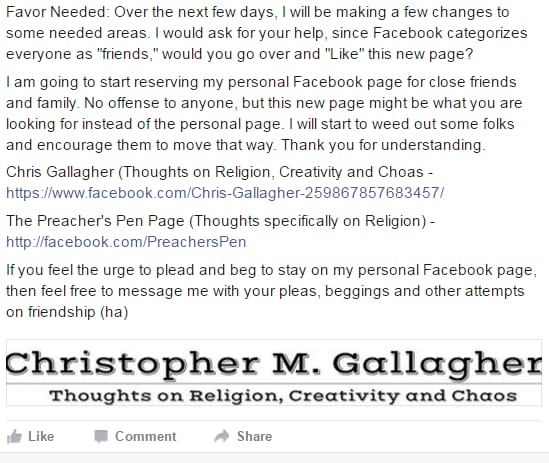
In light of those things, I decided to make a change. So a few days ago, I posted this:
In this process, I maybe be losing some “friends” but I am regaining my sanity. Honestly, I rarely peruse Facebook unless I am sitting on my couch in the evening. I have chosen this method to keep my sanity and keep the drama down.
To further simplify social media, I have deleted a few account on other platforms which never amounted to much. I deleted LinkedIn about a year ago after being stalked by people who had nothing better to do. (Yes, I said stalked. It is a long story, but it is amazing what people do.) There are certain areas of social media that people just have to have and I refuse to follow the status quo.
Now before you think I am against social media, I am not. I enjoy reconnecting with people I have not talked to in years and now using the opportunity to keep up with each other’s families. The ability to share information, articles, pictures and videos is a powerful tool to motivate and encourage people.
What changes have you made to social media?
Could you use a reduction in the drama of social media?
“Before you can change the world, you must change yourself.”
I have heard the above quote many times and have no idea who said it first. After working in what some call the “personal development field” for several years no, I have found the quote to be absolutely true. An individual must begin to change personally before they change the world. A salesman would say, “You must believe in the product you are selling or no one will believe you.” The same is true with change; one must be the change they want to see in others.
When we change, the world sees a change in us and they should want to make the positive change too. Here are some words found in the back of No More Mondays by Dan Miller (page 241) attributed as found on a tomb dated A.D. 1100 of an Anglican Bishop at Westminster Abbey:
When I was young and free and my imagination had no limits,
I dreamed of changing the world.
As I grew older and wiser, I discovered the world would not change,
so I shortened my sights somewhat and
decided to change only my country.
But it, too, seemed immovable.
As I grew into my twilight years,
in one last desperate attempt,
I settled for changing only my family,
those closest to me, but alas,
they would have none of it.
And now as I lie on my deathbed, I suddenly realize:
If I had only changed myself first,
Then by example I would have changed my family.
From their inspiration and encouragement,
I would have been able to better my country and,
who knows, I may have changed the world.
Paul Harvey’s voice spoke through thousands of radios every day. His gentle, echoing voice was and still is one of the most recognizable voices of the past 100 years. Each word was well thought out before making its way to the airwaves. Mr. Harvey could say some of the hardest phrases, but his character and gentle voice could make it calming to the soul. Take a moment today and let Paul Harvey’s voice from 2007 sooth your mind and challenge you for the day.
Before the 2012 Presidential Election, I found myself at my desk writing a sermon that I was not sure how it would be received. As it seems, every presidential election puts our nation at a crucial turning point. Some believe the nation is in a spiral towards the bottom and other still believe our nation is the greatest nation ever to exist. Whatever your belief, you know there is a Supreme Ruler whose words speak to mean today.
The text of that sermon from 2012 is below and no matter who is elected, there are principles we must consider. It is a lengthy reading, but one I think will you will gain something before you get to the end. Let the words challenge you, no matter your political position.
I believe we must consider the same words today.
Enjoy.
Sermon – November 4th, 2012
As I speak this morning, my topic is one in which very few will wade into the water and fewer will even dive as I will today. My goal today is to allow this topic to shine light on a few areas once unknown and shine light to others that we thought we might have known. Basically, to make you think about what is coming. This topic is on many of your minds today and will remain there throughout this week.
Due to the nature of the topic, I have already written out, word for word, the lesson I am presenting today. I will be reading my thoughts to you this morning, so bear with me as the delivery will be much different from normal. Due to its size, a limited number of copies of the lesson will be available on the information table, next to the bulletins, following services. If you prefer to have a copy emailed to you, I would be glad to email you one.
Today’s topic is one many have submitted because they have believed the opinions of others instead of searching the facts to find out whether or not the issue is just. A “just” issue is one where the real evidence may be different from the wager of human thought. The evidence might be clearly seen only to be diluted in the schemes of man and it is to our benefit to search out and challenge ourselves to find out what we should do in our current situation. Remember, the choices of the present will many times determine the outcomes of the future.
Before I proceed any further, let me begin by saying that I am proud of the country in which I live. I know she is not perfect. The people of this land have participated in sinful works and sinful atrocities; such as Fort Pillow. (Personal note: if you decide to read about Fort Pillow, make sure you are calm and far from any food.) In spite of the country’s faults, the good always outweighs the bad. She is the first to respond to problems across the world; providing food, shelter and protection. Further, she has been a saving grace to many who have come to her seeking refuge, peace and a new start.
A few weeks ago, I hung a new United States flag from our porch. The old one remains folded on a shelf, worn and battered by the constant South Carolina breeze. The new one is bright and exuberant. The colors shine in the sun as the wind waves this symbol of a free land. As one President said,
“The United States remains the last best hope for a mankind plagued by tyranny and deprivation. America is no stronger than its people — and that means you and me. Well, I believe in you, and I believe that if we work together, then one day we will say, “We fought the good fight. We finished the race. We kept the faith.” And to our children and our children’s children, we can say, “We did all what could be done in the brief time that was given us here on earth.”
My ties to this country run deep. I am not a native, but a descendant of Irish immigrants. I am not sure when we arrived, but we did. Our family has ties to national pride from battles near and far. From a grandfather who served as a cook in the National Guard during wartime, to another grandfather who flew missions over “The Hump.” (The Hump was route flown in the Second World War to the eastern end of the Himalayan Mountains to resupply forces.) Further, my biological father walked the swamps of Vietnam to fight for a people he did not know and when he returned, he had fewer friends and two purple hearts. I am sure he would give those purple hearts away, to have the life of his friends again. Many other family members still serve, others served this country in the past and some fought for freedom in other lands. From cousins who serve today, to a cousin wounded as an Army Ranger Afghanistan, the ties to the battles run deep.
My ties are further deepened when I realize my immigrant relatives came to this land because of new opportunities and new freedoms. Their desire was for a stronger life in a new land; possibly just as your relatives had come here too. The words on Ms. Liberty’s pedestal might have been written for my family,
“Give me your tired, your poor, your huddled masses yearning to breathe free. The wretched refuse of your teeming shore; send these, the homeless, tempest-tossed to me. I lift my lamp beside the golden door!”
My desire is stronger than it has ever been for a better life. My desire is not only for a better life for myself, but for Carrie and for my children. As my children grow, I wish them more opportunities and a greater life than I have ever achieved or will achieve; just as any parent would. The question I have to ask myself is, “What am I doing to make their lives better? Am I making a difference or being a person of indifference?” Those are hard questions, but hard questions deserve hard answers.
So today, I come to you, with a challenge. This is not just any challenge, but one that finds its premise and power in the engrafted Word of God written on your hearts. If, as Christians, we cannot find the word written on our hearts, then we are a people to be most pitied.
The reason for the challenges is that we live in a nation filled with opportunities that many in this world never face. Some of those opportunities we take advantage of without a thought, while others we appreciate more dearly because of people’s sacrifice to make our nation free. One of the rights many of you will express this week is the voting process.
On Tuesday, some of you will walk into a voting booth and walk out having picked a candidate or candidates you feel will be right to lead our country until the next election. I am not here to tell you which candidate or candidates to vote for. If, as logical people, we have studied their principles, then we know their positions. The principles of any candidacy should be valued, because in casting our vote, we cast support. Contrary to current culture, our values of Christianity go into the voting booth with us; that is why we must examine what we do in accordance with Biblical principles.
Christians seek to have the Bible is preached in all aspects of society, but why do some leave it off when it comes to politics? Christians cannot put their beliefs aside for any reason because our beliefs are founded in the Son of the Almighty, not in the candidacy of a man. The words of the Bible, what we should believe, were written before our nation existed and they will continue until after this nation is past.
I want to assure you again that I speak of no candidate or candidates this morning, but I speak of a hardship many will face because we have believed something that is not so. People have believed that there are two things we should never speak — politics and religion; but I submit to you this morning they are not inseparable. Some dislike the discussion of politics and religion because it reveals the inconsistencies in which we live. A few weeks ago, we spoke of Josiah and his reign over the nation. The Bible clearly speaks of the nation’s leader when it says,
“And he did what was right in the eyes of the LORD and walked in all the way of David his father, and he did not turn aside to the right or to the left.” (2 Kings 22:2; ESV)
“And the king went up to the house of the LORD, and with him all the men of Judah and all the inhabitants of Jerusalem and the priests and the prophets, all the people, both small and great. And he read in their hearing all the words of the Book of the Covenant that had been found in the house of the LORD.” (2 Kings 23:2; ESV)
“And the king commanded Hilkiah the high priest and the priests of the second order and the keepers of the threshold to bring out of the temple of the LORD all the vessels made for Baal, for Asherah, and for all the host of heaven. He burned them outside Jerusalem in the fields of the Kidron and carried their ashes to Bethel.” (2 Kings 23:4; ESV)
Josiah’s faith in God (that is, his religion) fueled his desire to see a nation living for the Almighty again. Josiah challenged the people because his faith challenged him. His faith was not separate from his work, his words or his politics, and neither should ours.
God has always been involved in politics and He always will be. He did not set the Earth in motion to step back and watch it spin; instead, He knows the hairs on our head and the ways of man. Was it not God that anointed Saul, befriended David and gifted Solomon? Was is not God’s Son who spoke to Pilate of his (that is, Pilate’s) own power in John 19.10-11,
“So Pilate said to him, ‘You will not speak to me? Do you not know that I have authority to release you and authority to crucify you?’ Jesus answered him, ‘You would have no authority over me at all unless it had been given you from above. Therefore, he who delivered me over to you has the greater sin.'”
Consider Paul’s words in Romans 13,
“Let every person be subject to the governing authorities. For there is no authority except from God, and those that exist have been instituted by God. Therefore, whoever resists the authorities resists what God has appointed, and those who resist will incur judgment. For rulers are not a terror to good conduct, but to bad. Would you have no fear of the one who is in authority? Then do what is good, and you will receive his approval, for he is God’s servant for your good. But if you do wrong, be afraid, for he does not bear the sword in vain. For he is the servant of God, an avenger who carries out God’s wrath on the wrongdoer. Therefore, one must be in subjection, not only to avoid God’s wrath but also for the sake of conscience. For because of this you also pay taxes, for the authorities are ministers of God, attending to this very thing. Pay to all what is owed to them: taxes to whom taxes are owed, revenue to whom revenue is owed, respect to whom respect is owed, honor to whom honor is owed.” (Romans 13:1-7; ESV)
God knows man, but sometimes man forgets God.
Christians have believed in the quietness of religion and politics for too long because we hear words like “separation of Church and State” while believing the lie that somehow we can separate our Biblical principles from any area of our life. Can a Christian separate himself from God in one area and be expected to be saved because of another? May a Christian continue to sin so grace may abound? Paul says, “By no means!” (ESV) “God forbid!” (KJV)
Consider the foundations of our land and the freedoms that we enjoy. Our freedom in our Earthly nation lends itself to opportunities in our religion; even though current thinking pushes religion aside.
Consider the words of Alexis De Tocqueville, a French historian and politician, in his work, Democracy in America,
“There is no country in the whole world in which the Christian religion retains a greater influence over the souls of men than in America – and there can be no greater proof of its utility, and of its conformity to human nature, than that its influence is most powerfully felt over the most enlightened and free nation of the Earth.”
The influence of Christianity is our country is clearly seen in the battles that rage frequently in our land. Debates over displaying Ten Commandments, students wearing religious t-shirts to school or pictures of Jesus in public, are battles, which begin to put religion on trial, and seek to remove religion from the public eye. Our generations of political correctness and subjective truth have propagated lies in which many Christians have submitted. The world silences Christians instead of Christians bring silence to the sinful world’s demands. The world has been hostile to the Almighty, because the world seeks its own and not the things of God. Even the world in the book of Acts had their world-view backwards as evidences when they declared the followers of Christ were turning the world upside down instead of right-side up in Acts 17.6.
While some dispute about religion’s place in our nation, our national history allows us a glimpse into the eyes of the past to bring light to the present.
Consider the Declaration of Independence. When those 56 men gathered to sign the Declaration they came with a cause, but they included the name of God in this founding document. (There are five references to God in the text of the Declaration.) Regarding the signers and religion, some will quickly point a finger at two prominent signers and say they were not religious and therefore, our nation’s founding should not be one of religion. The skeptics pick two out of 56, so let us look at those two men – Thomas Jefferson and Benjamin Franklin.
Regarding those two men, we must remember it was Benjamin Franklin who drafted a statewide prayer proclamation for Pennsylvania, recommended Christianity as a part of the public school and desired to start a colony in Ohio for the introduction of “pure religion among the heathen.” (Barton, The Role of Pastors and Christians in Civil Government, Page 23, 24)
It was Thomas Jefferson who recommended the Great Seal of the United States depict a Bible story and include God in the nation’s motto. Furthermore, President Jefferson negotiated a treaty with an Indian tribe that included federal funding to pay ministers to work with the tribe to construct a church building for the tribe to worship. (Barton, The Role of Pastors and Christians in Civil Government, Page 24)
With evidence of the religious leanings of Franklin and Jefferson, it is interesting to note that, of the 56 signers of the Declaration, half of them were educated in school established for the training of ministers and they received degrees that would be considered, today, to be from a seminary or a Bible School. This would be like politicians today receiving a degree from Freed-Hardeman University, David Lipscomb University, Harding University or similar.
Speaking of degrees, consider two of the prominent schools in our nation’s founding, which are still in existence today, which spoke of God, Christ and the Church. The motto of one spoke clearly as it said “For Christ and the Church” and “For the glory of Christ.” The motto has recently been changed only to be “Truth.” The school went further to speak of religion when it made as an education practice that,
“Everyone shall so exercise himself in reading the Scriptures twice a day that he shall be ready to give an account of his proficiency therein.”
The other school spoke to its students the following words,
“Above all, have an eye to the great end of all your studies, which is to obtain the clearest conceptions of Divine things and to lead you to a saving knowledge of God in His Son Jesus Christ.”
Looking at these schools today, the first school, Harvard, and the second, Yale, it is easy to see how they have left the moorings of their founding principles.
Since we are on the topic of schools, consider also the first public education law in 1647; this law was in effect before the Revolutionary War would be fought. The law, known as “The Old Deluder Satan Act” spoke these words, “It being one chief project of that old deluder, Satan, to keep men from the knowledge of the Scriptures, as former time…” The design of the Old Deluder Satan Act was o ensure the settlers, as common people, would have opportunity to read and learn God’s Word. (Barton, Four Centuries of American Education, page 16) Imagine that, an educational law enacted to ensure the Bible would be read; have times changed?
As the settlers laid foundations, the Revolutionary War brought a nation to a new beginning as it began to draft its own legislation. One of those early laws, the first federal law addressing education, was the “Northwest Ordinance.” The same founders who pass the First Amendment of the United States passed the “Northwest Ordinance”. This new federal law, in Article III, states,
“Religion, morality and knowledge, being necessary to good government and the happiness of mankind, school and the mean of education shall forever be encouraged.” (Barton, Four Centuries of American Education, page 19)
As you can see, religion played a major role in the morality of our society for generations. The evidence is clear in books such as the New England Primer of 1777. As stated in the Forward to the 2010 reprint, “The New England Primer, introduced in Boston in 1690 by Benjamin Harris, was the first textbook printed in America. For a century after its introduction, it was the beginning textbook for students; and until well into the twentieth century (there was a 1930 edition) it continued to be a principal text in all type of American schools…”
In the question and answer section of the New England Primer, Question 94, is “What is baptism?” Remember, we are talking of a textbook used in public school primer used in school for years, even well into the KJV. The answer to the question, “What is baptism” is as follows:
“Baptism is a sacrament wherein the washing of water in the name of the Father and of the Son and of the Holy Ghost, doth signify and seal our engrafting into Christ and partaking of the benefits of the covenant of grace, and our engagements to be the Lord’s.”
(As if a 2010 reprint was not good enough, I had to find and purchased a 1916 New England Primer that was used in schools. The Question and Answers in the 1916 edition are the same as the 2010 reprint.)
As members of the church, reading from this answer, reminds us of Peter’s response to the question, “What must we do to be saved?” Peter’s response was simple, “Repent and be baptized every one of you in the name of Jesus Christ for the remission of your sins and you will receive the gift of the Holy Spirit. This promise is not for you, but for all those who are afar off.” (Acts 2:37-39)
The education of morality in the lives of the generation that preceded the nation’s founders was emphasized regularly. Gouverneur Morris, called the “Penman of the Constitution,” wrote his recommendation on education by saying,
“Religion is the only solid basis of good morals; therefore, education should teach the precepts of religion and the duties of man toward God.” (Barton, Four Centuries of American Education, page 25)
Noah Webster was given the title, “Schoolmaster of America” and we have many of his words recorded in A Collection of Papers on Political, Literary and Moral Subjects, which read,
“The Christian religion is the most important and one of the first things in which all children under a free government ought to be instructed…No truth is more evident to my mind than that the Christian religion must be the basis of any government intended to secure the rights and privileges of a free people.” (Barton, Four Centuries of American Education, page 28)
These thoughts, as well as others, were not only the founding principles of our nation, but they were principles taught in school. Even well into the 1950’s schools taught the principles and even quoted from the words of the Sacred Text. They were not just words mentioned, but words taught as the principles to a free and moral society. Classes such as “The Bible Study Course: Old Testament” (Bulletin 150) and “The Bible Study Course: New Testament” (Bulletin 170) were authorized by the Board of Education and taught in Dallas High Schools in September 1954 and September 1946. (See photographs in Four Centuries of American Education, page 22)
At various times, the leaders of our nation saw fit to print and publish editions of a Bible for a variety of occasions. During World War II, our federal government printed Bibles that contained a letter from President Franklin D. Roosevelt. The letter states,
“As Commander-in-Chief I take pleasure in commending the reading of the Bible to all who serve in the armed forces of the United States. Throughout the centuries men of many faiths and diverse origins have found the in the Sacred Book words of wisdom, counsel and inspiration. It is a fountain of strength and now, as always, an aid in attaining the highest aspirations of the human soul.” Franklin D. Roosevelt.
The top of the page reads, “The White House Washington.”
Today, more than ever, our country, as well as others, need leaders who are not fearful of speaking about the Bible. Remember Josiah?
How far we have come in the past 100 years. Those a few years older than me have seen the battle rage from the beginning. My generation sees things quite different because our maturing years have brought us up in a different society than the “good ole days.” Many have seen our society changed in ways they never imagined. David Barton states the following in Four Centuries of American Education on page 46:
Voluntary Prayer forbidden (1962)
The inclusion of Scripture was terminated (1963)
Elective classes on Religion was halted (1948)
The Bible was ordered out of school libraries (1989)
Ten Commandment displays were ordered removed (1980)
Religious artwork was covered (1993)
Religious content in student papers and speeches was forbidden and even penalized, with students being given a zero if they wrote on a religious topic (1965, 1995)
Invocations were excluded from graduations and athletic events (1994)
Students were disciplined for bringing their personal Bibles to read during free reading time (1989)
Traditional Christmas programs were halted as was the practice of students giving Christmas cards (1979, 1980, 1988)
The names of previously celebrated holidays (e.g., Christmas, Thanksgiving, Easter, etc.) were changed to become secular (Fall Break, Winter Break, Spring Break)
Hearing or reading a list such as this makes one’s head spin because we recognize how our society can spin off its moorings when we examine the removal of religion from the public eye. Its removal from the public eye means we now harness its power in the private areas of our life only to be brought out on Sundays, possibly a Wednesday and maybe, just maybe in times of national tragedy.
While we hear of these changes, it is vital to understand the basis for such removal. Most have come to believe the fallacy of “The Constitution speaks of the separation of Church and State.” However, it doesn’t. To the surprised of many, the words “separation of Church and State” are not found within the Constitution of the United States. Men have mentally written them into the Constitution just as men have written “Cleanliness is next to godliness” into Solomon’s proverbs.
The people of God have heard the words “separation of Church and State” in each discussion of any religious area that is made public and any public area that is made religious. Because of the bombardment of the five words, “separation of Church and State,” Christians have watched the society around them changed more in the past 100 years than ever in our nation’s history. The decline of religion has seen the abundance of rising immorality. President Woodrow Wilson might have said it best,
“A nation which does not remember what it was yesterday, does not know what it is today, nor what it is trying to do. We are trying to do a futile thing if we do not know where we have come from, or what we have been about.”
The influence of the “separation of Church and State” argument must be met from its origin, not what men read into it today. While I have already mentioned “separation of Church and State” is not found in the Constitution, its origin must be found. In October 1801, the Danbury Baptist Association (Danbury, Connecticut) wrote a letter to President Thomas Jefferson regarding protection for religion and its place in the laws and Constitution of the United States. In the response, President Jefferson wrote,
“Believing with you that religion is a matter which lies solely between a man and his God…I contemplate with sovereign reverence that act of the whole American people which declared that the legislature should make “no law respecting an establishment of religion or prohibiting the free exercise thereof,” thus building a wall of separation between Church and State.”
What most people remember most is “separation of Church and State” and not the reference to the Establishment Clause and the Free Exercise Clause of the First Amendment. The Establishment Clause prohibited and prohibits the federal government from establishing a single national denomination; the Free Exercise Clause prohibited and prohibits the federal government from interfering with the people’s public religious expression and acknowledgments.
It is, through a reading of the documents of the Founding Fathers, they did not wish for a single religious denomination (such as “The Church of England”) but they did desire that all men find the basic principles taught in the Bible to be part of society. This is evidenced in documents of the Founders regarding God and government. One such occurrence is the Farewell address of George Washington. In his Farewell address to the nation, President Washington said,
“Of all the dispositions and habits which lead to political prosperity, religion and morality are indispensable supports. In vain would that man claim the tribute of patriotism, who should labor to subvert these great pillars of human happiness – these firmest props of the duties of men and citizens. The mere politician, equally with the pious man, ought to respect and to cherish them.” (Barton, Separation of Church and State, page 10, 11)
As the words “separation of Church and State” will be debated for years to come, the greater question we must ask is, “Have we become influenced to a great fallacy?” Have we fallen into the false life of separating our religion from our politics?” To do so is a greater problem than “separation of Church and State” it is a separation of self from Christ.
Maybe this is answered by asking the hard questions,
Have our children heard us speak more of a political party than they have of the Christian family?
Do we know more of the views of a candidate that the words of the Messiah?
Have others heard us speak more of a candidate than we have of the Savior?
Have others heard our complaints over taxation rather than the loss of 51 million Americans since Roe vs. Wade? (Is life not more valuable than money?)
Have we believed that our politics should remain separate than our Christian life?
Better yet, who is on control?
Should we separate our Christian life from our political life? Absolutely not.
The question of the day is not which candidate will win, but how will you and I feel about the candidate who wins. Tuesday night, maybe even very early Wednesday morning, the results of Election Day 2012 will be released. When they are released, this nation’s citizens will have chosen a new President or the reelection of the current President. With either result, there will be some filled with joy and others filled with cursing. Some will be excited and some will grieve with much sorrow.
Whether you rejoice or grieve, will your faith in the Lord be shaken?
Will your “election rejoicing” be greater that your rejoicing in Christ? If so, we are a people to be most pitied.
On the other hand, will your “election sorrow” be greater than your sorrow over sin or a lost brother or sister? If so, we are a people to be most pitied.
I can assure you this morning our problems will not be solved by a human man. Since the beginning, man has been the troubling factor. Man thinks he knows greater than God, yet God always wins.
I admit to you this morning, I stand here as a man who has made mistakes and will make more. I stand as a man condemned because it is my sins that have separated me from God (Isaiah 59.1, 2). It is not because of some man my life is made greater, if is because of the only Son of God my life is great (John 3.16).
As Christians, while we may fulfill our national freedom to cast our vote but there is a greater freedom to which we must heed. True freedom is found in only one man — Jesus (Galatians 3.28). There is life in only one man — Jesus (John 10.10), and He is not running for President and He never will. Some consider Him a leader; other a liar, but those who seek the Truth consider him a Savior. It was Jesus that Isaiah speaks in Isaiah 53.3-10,
“He was despised and rejected by men; a man of sorrows, and acquainted with grief; and as one from whom men hide their faces he was despised, and we esteemed him not. Surely he has borne our griefs and carried our sorrows; yet we esteemed him stricken, smitten by God, and afflicted. But he was wounded for our transgressions; he was crushed for our iniquities; upon him was the chastisement that brought us peace, and with his stripes we are healed. All we like sheep have gone astray; we have turned–everyone–to his own way; and the LORD has laid on him the iniquity of us all. He was oppressed, and he was afflicted, yet he opened not his mouth; like a lamb that is led to the slaughter, and like a sheep that before its shearers is silent, so he opened not his mouth. By oppression and judgment, he was taken away; and as for his generation, who considered that he was cut off out of the land of the living, stricken for the transgression of my people? And they made his grave with the wicked and with a rich man in his death, although he had done no violence, and there was no deceit in his mouth. Yet it was the will of the LORD to crush him; he has put him to grief; when his soul makes an offering for guilt, he shall see his offspring; he shall prolong his days; the will of the LORD shall prosper in his hand.”
Of whom will you speak of tomorrow? Jesus or man?
Of whom will you speak of on Tuesday? Jesus or man?
Of whom will you rejoice on Wednesday? Jesus or man?
Allow me today to close with the words of Alexis De Tocqueville,
“I sought for the greatness of the United States in her commodious harbors, her ample rivers, her fertile fields, and boundless forests–and it was not there. I sought for it in her rich mines, her vast world commerce, her public school system, and in her institutions of higher learning–and it was not there. I looked for it in her democratic Congress and her matchless Constitution–and it was not there. Not until I went into the churches of America and heard her pulpits flame with righteousness did I understand the secret of her genius and power. America is great because America is good, and if America ever ceases to be good, America will cease to be great!”
If a Frenchman can understand it is not in a country that we find genius and power, it is in the church – the body of Christ.
May we, today, seek to know more of the church than we do the thoughts of man. May we seek to live in the light of Christ as opposed to the
Remember we are foreigners in this land as we look to the One to come. It was Paul who said,
“But our citizenship is in heaven, and from it we await a Savior, the Lord Jesus Christ, who will transform our lowly body to be like his glorious body, by the power that enables him even to subject all things to himself.” (Philippians 3.20-21; ESV)
Where is your joy, your life, your treasure? Matthew says, “For where your treasure is, there your heart will be also.” (Matthew 6.21)
Let us resolve to rejoice in God, not in man.
Sources Cited:
#1 – The Role of Pastors and Christians in Civil Government by David Barton
#2 – Four Centuries of American Education by David Barton
#3 – Separation or Church and State by David Barton
#4 – Holy Bible, King James Version printed by the Federal Government
#5 – The New England Primer, 2010 reprint, Wall Builders
#6 – The New England Primer, 1916, Ginn and Company
Personal Note:From the first reading of this article, I was enthralled. My copy is tucked away in my digital filing cabinet, but this one came through an email list I am on (Mikey’s Funnies). Take a moment and let this article sink in. (Mr. Ogan uses the words pastor and minister interchangeably. I left the words as he wrote them.)
I’ll never forget Easter 1946. I was 14, my little sister Ocy was 12,and my older sister Darlene 16. We lived at home with our mother, and the four of us knew what it was to do without many things. My dad had died five years before, leaving Mom with seven school kids to raise and no money.
By 1946 my older sisters were married and my brothers had left home. A month before Easter the pastor of our church announced that a special Easter offering would be taken to help a poor family. He asked everyone to save and give sacrificially.
When we got home, we talked about what we could do. We decided to buy 50 pounds of potatoes and live on them for a month. This would allow us to save $20 of our grocery money for the offering. When we thought that if we kept our electric lights turned out as much as possible and didn’t listen to the radio, we’d save money on that month’s electric bill. Darlene got as many house and yard cleaning jobs as possible, and both of us babysat for everyone we could. For 15 cents we could buy enough cotton loops to make three pot holders to sell for $1.
We made $20 on pot holders. That month was one of the best of our lives.
Every day we counted the money to see how much we had saved. At night we’d sit in the dark and talk about how the poor family was going to enjoy having the money the church would give them. We had about 80 people in church, so figured that whatever amount of money we had to give, the offering would surely be 20 times that much. After all, every Sunday the pastor had reminded everyone to save for the sacrificial offering.
The day before Easter, Ocy and I walked to the grocery store and got the manager to give us three crisp $20 bills and one $10 bill for all our change.
We ran all the way home to show Mom and Darlene. We had never had so much money before.
That night we were so excited we could hardly sleep. We didn’t care that we wouldn’t have new clothes for Easter; we had $70 for the sacrificial offering.
We could hardly wait to get to church! On Sunday morning, rain was pouring. We didn’t own an umbrella, and the church was over a mile from our home, but it didn’t seem to matter how wet we got. Darlene had cardboard in her shoes to fill the holes. The cardboard came apart, and her feet got wet.
But we sat in church proudly. I heard some teenagers talking about the Smith girls having on their old dresses. I looked at them in their new clothes, and I felt rich.
When the sacrificial offering was taken, we were sitting on the second row from the front. Mom put in the $10 bill, and each of us kids put in a $20.
As we walked home after church, we sang all the way. At lunch Mom had a surprise for us. She had bought a dozen eggs, and we had boiled Easter eggs with our fried potatoes! Late that afternoon the minister drove up in his car. Mom went to the door, talked with him for a moment, and then came back with an envelope in her hand. We asked what it was, but she didn’t say a word. She opened the envelope and out fell a bunch of money. There were three crisp $20 bills, one $10 and seventeen $1 bills.
Mom put the money back in the envelope. We didn’t talk, just sat and stared at the floor. We had gone from feeling like millionaires to feeling like poor white trash. We kids had such a happy life that we felt sorry for anyone who didn’t have our Mom and Dad for parents and a house full of brothers and sisters and other kids visiting constantly. We thought it was fun to share silverware and see whether we got the spoon or the fork that night.
We had two knifes that we passed around to whoever needed them. I knew we didn’t have a lot of things that other people had, but I’d never thought we were poor.
That Easter day I found out we were. The minister had brought us the money for the poor family, so we must be poor. I didn’t like being poor. I looked at my dress and worn-out shoes and felt so ashamed–I didn’t even want to go back to church. Everyone there probably already knew we were poor!
I thought about school. I was in the ninth grade and at the top of my class of over 100 students. I wondered if the kids at school knew that we were poor. I decided that I could quit school since I had finished the eighth grade. That was all the law required at that time. We sat in silence for a long time. Then it got dark, and we went to bed. All that week, we girls went to school and came home, and no one talked much. Finally on Saturday, Mom asked us what we wanted to do with the money. What did poor people do with money? We didn’t know. We’d never known we were poor. We didn’t want to go to church on Sunday, but Mom said we had to. Although it was a sunny day, we didn’t talk on the way.
Mom started to sing, but no one joined in and she only sang one verse. At church we had a missionary speaker. He talked about how churches in Africa made buildings out of sun dried bricks, but they needed money to buy roofs. He said $100 would put a roof on a church. The minister said, “Can’t we all sacrifice to help these poor people?” We looked at each other and smiled for the first time in a week.
Mom reached into her purse and pulled out the envelope. She passed it to Darlene. Darlene gave it to me, and I handed it to Ocy. Ocy put it in the offering.
When the offering was counted, the minister announced that it was a little over $100. The missionary was excited. He hadn’t expected such a large offering from our small church. He said, “You must have some rich people in this church.”
Suddenly it struck us! We had given $87 of that “little over $100.”
We were the rich family in the church! Hadn’t the missionary said so? From that day on I’ve never been poor again. I’ve always remembered how rich I am because I have Jesus!